“Targeted Return is structured as a multi-asset fund with equities capped at 40%, with average equity allocation over the last 5 years sitting in the 20–25% range. It leverages Ashburton’s fixed income and credit capabilities, and is well suited to volatile markets, because it is geared to capture upside and protect on the downside, with its Q1 2025 performance – when the global markets were impacted by big political events – as a strong example of this,” Mvulane explains.
“A key achievement of the fund is the fact that it has met both its primary and secondary objectives over the last three to five years. Over a three-year period, the fund delivered a 14.4% return, and over a five-year period, a 12.1% return where it sits in the first quartile. It also outperformed CPI + 3.5% by 6.9% over three years and 3.7% over five years.”

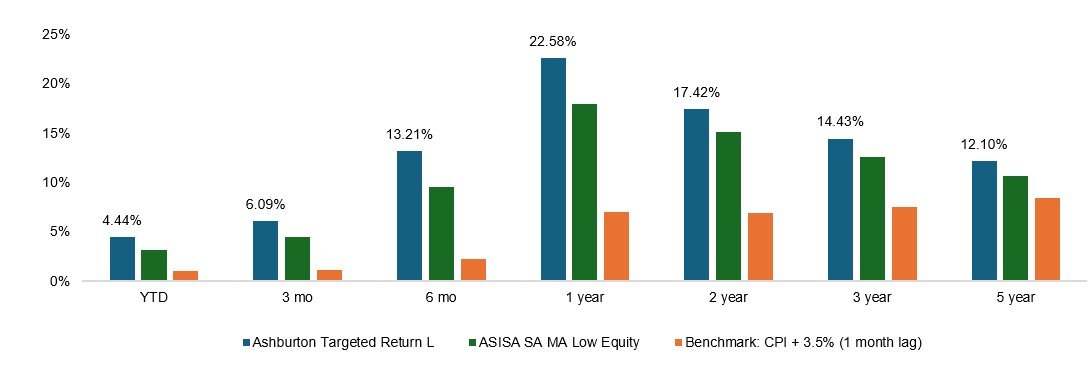
Source: Morningstar, ASISA, Ashburton Investments.
*Past performance is not necessarily a guide to future performance
Why the Targeted Return Fund meets investors’ needs
“With a disciplined approach that delivers low volatility, the fund stands out by leveraging our strong fixed-income capabilities to provide consistent, risk-managed absolute returns for institutional and other investors. It can essentially be described as an ‘absolute return fund’ with capital preservation and no capital losses over a 36-month rolling period,” says Mvulane.
“As a cautious low-equity fund, it employs asset allocation, currency diversification, credit exposure, duration management, and derivative strategies to enhance returns. The goal of the fund is to provide a single solution for the low-risk component of a portfolio or the destination for the conservative investor looking for the higher returns that can be obtained when a wide array of asset classes is available. Its recent performance was driven by broad-based gains across local fixed income, inflation-linked bonds, equities, and property, complemented by global asset exposure,” says Mvulane.
Ashburton’s Targeted Return Fund is constructed using a diversified, multiasset approach, anchored in fixed income and complemented by selective allocations to equities and alternative assets. This structure has proven effective in capturing upside while maintaining low volatility and limited drawdown risk, as demonstrated under recent market conditions.
Market context for multi-asset growth
We are currently monitoring the interest rate environment closely, both domestically and internationally. In the United States, the outlook could shift should a political appointee succeed Federal Reserve Chair Jerome Powell when his term concludes in May.
In South Africa, conditions appear relatively stable for now, following the previous South African Reserve Bank’s (SARB) monetary policy committee decision on 29 January, to keep interest rates unchanged. The repo rate remains at 6.75%, with the prime lending rate at 10.25%. Headline inflation dropped to 3.5% in January from 3.6% in December, exceeding the SARB’s 3% target but remaining within its onepercentagepoint tolerance band.
While the SARB’s inflation forecasts of 3.3% for 2026 and 3.2% for 2027 suggest a stable inflation trajectory, these outcomes will need to be closely monitored. If realised, they point to a period of macroeconomic stability rather than a phase of strong cyclical growth, given that South Africa’s growth constraints remain largely structural rather than inflationdriven,” said Tlhoni Komako, Fixed Income Portfolio Manager.
“Against this backdrop, we will assess whether South African assets continue to deliver strong returns. The rand appreciated significantly against the US dollar in the past year, aided by the dollar’s depreciation on the one end, wide interestrate differentials and improving domestic credibility following a wellreceived 2026 National Budget, which reinforced expectations of fiscal consolidation and debt stabilisation. There’s been optimism around South Africa’s removal from the Financial Action Task Force (FATF) grey list and strong performance of South African stocks and bonds on the other – so that’s another factor to watch.” While escalating conflict in the Middle East has driven episodic riskoff moves and shortterm spikes in oil prices, recent macro analysis suggests that basecase scenarios assume any oil supply disruptions are likely to be temporary, limiting the longerterm inflationary impact on South Africa.
Outlook for the future
Looking ahead, the macro environment remains supportive for South African fixed income, with improving fiscal dynamics, attractive real yields and favourable commodity prices likely to sustain positive momentum, says Mvulane.
“However, risks persist, including global policy uncertainty and domestic structural challenges. The Targeted Return Fund remains well-positioned to navigate these dynamics, leveraging its diversified mandate and tactical flexibility to deliver consistent real returns.”