- Global Markets Overview - June 2026
Global Markets Overview - June 2026
07 June 2026

Ashburton Investments
Share via:


Brent crude oil erased all wartime gains on the United States (US)-Iran interim peace deal, but a sharp late-month technology selloff and fresh military clashes between Washington and Tehran sent global equities lower, reversing much of May's momentum.
June delivered a broad reversal of May's gains with the MSCI World Index and Emerging Market Index giving back ~2.4% and ~2.3%, respectively, as a swift rotation out of artificial intelligence (AI) -linked semiconductor stocks unwound a significant portion of the prior two months' rally. The dominant narrative shifted mid-month towards the landmark US-Iran interim peace deal which reopened the Strait of Hormuz and sent oil prices sharply lower, initially lifting equities and easing global inflationary fears. However, a second major theme quickly asserted itself as concerns emerged over stretched AI valuations and hyperscaler capital expenditure sustainability. This, and a reported delay to ChatGPT owner OpenAI's IPO, triggered a severe late-month selloff in semiconductor and mega-cap technology stocks that overwhelmed the “peace rally”. By month-end, fresh US-Iran military exchanges had placed the ceasefire under acute strain once more, compounding the risk-off tone.
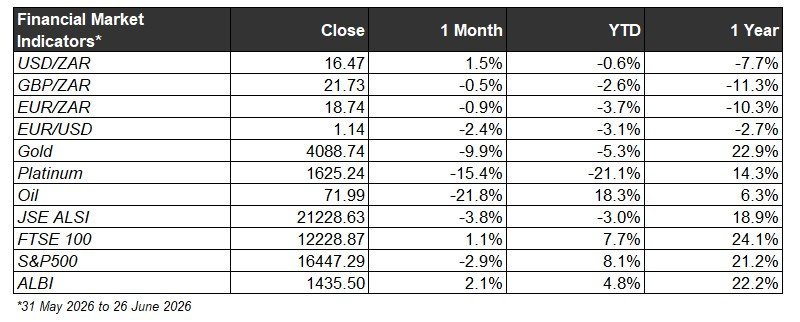
In the US, the S&P 500 fell ~2.9% in June, with the {“Magnificent Seven” cohort broadly lower (-12.2%) and accounting for the bulk of the index's decline. Microsoft led the losses (-17.2%), followed by Amazon (-14%), Meta (-12.9%), Tesla (-12.9%), Alphabet (-11.2%), Nvidia (-8.7%) and Apple (-9%). The AI capital expenditure debate intensified as rising bond yields, driven by Federal Reserve (Fed) hawkishness under new Chairman Kevin Warsh, weighed on long-duration growth stocks.
Moving over to Europe, the Euro Stoxx 50 was a notable outperformer, rising ~2.9%, as the sharp retreat in oil prices provided meaningful relief to energy-import-dependent economies.
The performance across Asia remained broadly subdued with the MSCI Asia Pacific Index down ~2% despite some divergence in key regions. South Korea's KOSPI fell ~0.8% for the month, despite SK Hynix, one of the "triopoly" memory manufacturers, surging ~14.9%. The overall index was dragged lower by a rapid mid-to-late month selloff that saw the KOSPI plunge ~10% from its record high in a single session as AI valuation concerns spread. Hong Kong's Hang Seng was among the worst performers, declining ~9.4%, as the China Enterprises Index entered bear market territory amid tepid consumer spending and fading confidence in regional e-commerce names. Japan's Nikkei 225 (+4.6%) bucked the regional trend amid a confluence of tailwinds, with significant yen weakness providing meaningful support for Japan’s export-heavy index. To some extent, the Bank of Japan's (BoJ) rate hike also signalled confidence in the domestic recovery.
Locally, the JSE All Share Index declined 3.8% (-5.2% in US dollar terms) as sentiment was pressured by deteriorating economic indicators, with consumer confidence falling to -19 points, business confidence (2Q26: 39 vs 1Q26: 47 points) reaching its lowest level since 3Q25, and producer inflation accelerating to a three-year high of 7.8% year-on-year (y/y) in May amid rising fuel costs. On a more constructive note, government bond yields fell to their lowest levels since the start of the US-Iran war, as declining oil prices eased inflation concerns. That said, investors remain focused on the South African Reserve Bank’s (SARB) upcoming policy meeting in July, with markets pricing in a modest probability of a further hike.
June was a pivotal month for global monetary policy given the disruptions stemming from the Middle East conflict. The European Central Bank (ECB) hiked rates by 25-basis points (bps) to 2.25%, its first hike in three years, and signalled readiness to hike again in July if inflation pressures persist. Though by month-end, falling oil prices had led traders to pare back further tightening expectations to below a full quarter-point. In the US, the Fed held rates unchanged at its June meeting, but the updated dot plot and Warsh's debut press conference signalled growing internal support for a rate hike later in 2026. The BoJ raised its benchmark rate by 25bps to 1.0%, the highest since 1995, and pledged to stabilise government bond purchases, marking a further step in its policy normalisation.

The defining commodity development of June was the swift reversal of Brent crude's wartime premium. Brent opened the month at ~$95/barrel and fell to ~$72/barrel – a decline of roughly 24% – amid heightened expectations of a rapid return of Persian Gulf supply. The decline remains non-linear amid several ceasefire violations impacting the pace of supply normalisation. Precious metals faced renewed pressure as the peace deal strengthened the US dollar and reduced safe-haven demand – gold ended the month at ~$4 088/oz. (-9.9%) and platinum swung lower to ~$1 625 (-15.4%). The Bloomberg Agriculture Spot Index retreated ~3.2% as some supply disruption fears moderated following the Hormuz reopening, though the index remains historically elevated given residual fertiliser and shipping disruptions.

Markets are entering July with a more cautious disposition than at the start of June. The 60-day clock on the US-Iran memorandum of understanding is now running, with mediators reporting that “encouraging progress” has been made with technical-level nuclear talks despite a few setbacks. Looking ahead, the market performance in July is likely to hinge on three key factors: the durability of the Middle East ceasefire and the uninterrupted reopening of the Strait of Hormuz, whether the US Fed’s hawkish pivot materialises into an actual rate hike, and whether the AI-driven investment theme can stabilise following growing valuation concerns after the sector's strong gains.

*Written by the FNB Wealth and Investments Research team
Our team of investment specialists is ready to discuss how we can help you achieve your financial objectives.
Our team of investment specialists is ready to discuss how we can help you achieve your financial objectives.