- Global markets’ stellar recovery stumbles amid renewed uncertainty over Middle East tensions
Global markets’ stellar recovery stumbles amid renewed uncertainty over Middle East tensions
08 May 2026

Ashburton Investments
Share via:


Same trusted investment partner. Fresh new experience. Trust that you discover a faster, simpler and more intuitive online experience.
Beware of WhatsApp fraudsters using our name. We never offer investments or request personal info on WhatsApp.

Ashburton Fund Managers (Proprietary) Limited is a licensed Financial Services Provider ("FSP") in terms of the Financial Advisory and Intermediary Services Act, 37 of 2002, FSP number 40169, and Ashburton Management Company RF (Pty) Ltd is an approved manager of Collective Investment Schemes in terms of Collective Investments Scheme Control Act, 45 of 2002 by the Financial Sector Conduct Authority (FSCA) and is also a full member of the Association for Savings and Investment SA (ASISA).

2 Merchant Place, 1 Fredman Drive, Sandton, Johannesburg, 2196

+27(0) 860 000 339
Fully Invested
© 2026 Ashburton Investments. All rights reserved.

Risk assets under pressure as diplomatic stalemate deepens and energy prices surge to wartime highs
April delivered a powerful reversal of March's losses, as global equity markets staged one of their strongest monthly rallies in recent years. The MSCI World Index surged 8.4% for the month, while the MSCI Emerging Markets Index climbed 16%, with emerging markets outperforming as geopolitical risk premiums unwound. However, the ceasefire that had mostly held since early April appears increasingly fragile, with Brent crude oil prices surging past $115 a barrel towards month end as the US-Israel-Iran conflict continued into its ninth week. Diplomatic efforts to fully resolve the conflict have stalled, with President Trump reportedly telling aides to prepare for an extended blockade of Iran, creating renewed uncertainty as the month drew to a close.
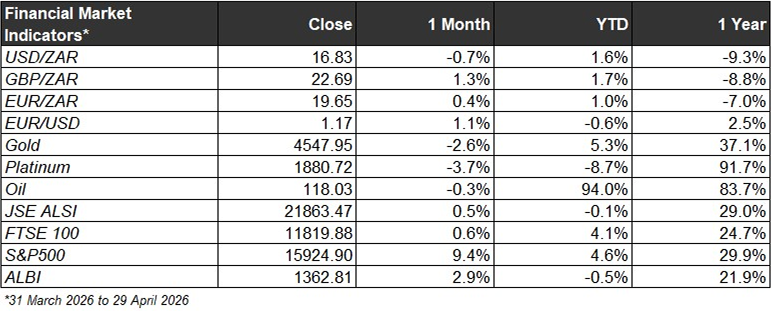
Among developed markets, the US led the recovery with the S&P 500 advancing 9.4%, reaching record highs and posting one of its best months since the depths of the pandemic. The rally was driven by strong corporate earnings, particularly from mega-cap technology companies. April marked a powerful rally for the Magnificent 7 stocks, with six of the seven posting double-digit gains, led by Amazon (+26.3%), Nvidia (+20%), Alphabet (+21.7%), Meta (+15.3%), and Microsoft (+17%), while Apple rose 6.5% and Tesla was relatively flat. The surge was driven by heightened optimism around AI infrastructure spending, with JP Morgan forecasting an unprecedented $200 billion capital expenditure boom among top US hyperscalers. European markets also rebounded, with the Euro Stoxx 50 rising 5%, though gains were more modest than US peers as energy import concerns persisted – the rally in oil prices and the prospect of a prolonged disruption to the Strait of Hormuz stoked inflation and growth concerns. China delivered comparatively marginal gains (MSCI China Index: +2.7%) as the region lacked the powerful earnings catalysts (particularly from mega-cap tech) that drove the US rally and faced headwinds from slowing economic momentum, ongoing US-China tensions, and tightening monetary conditions. South African equities underperformed significantly, with the JSE All Share Index giving back earlier gains to close the month almost flat (+0.5%; USD terms: +1.7%), with the rand weakening from a monthly low of R16.16 per dollar to ~R16.83 by month-end. The month's losses reflected South Africa's vulnerability to multiple headwinds as a net-importer of petroleum products facing surging energy prices, declining precious metal prices (as a major exporter), and broader emerging market risk-off sentiment.
Major central banks kept interest rates unchanged at their April meetings but maintained cautious, data-dependent stances amid lingering inflation concerns. The Bank of Japan kept its short-term policy rate unchanged at 0.75% at its April meeting, leaving borrowing costs at their highest level since September 1995 amid ongoing uncertainty over the Iran conflict and surging energy prices. While the US Federal Reserve (Fed) also maintained its benchmark interest rate at 3.50% to 3.75%, the decision revealed deep divisions within the committee. The vote was 8-4, marking the most dissents in 34 years. Jerome Powell, in his final meeting as Fed chair, noted that while the labour market remains solid, elevated energy prices from the Middle East conflict have made the inflation path uncertain, requiring a cautious, adaptive approach. As widely expected, the European Central Bank (ECB) followed suit, and kept its main refinancing rate steady at 2.15% and the deposit facility at 2%. The bank’s hawkish pause underscores intensifying upside risks to inflation colliding with downside risks to growth.

Commodity markets delivered sharply divergent performances in April, with energy leading gains while precious metals retreated. Crude oil surged dramatically to above $115 per barrel, reversing earlier declines from March peaks, as the Washington-Tehran diplomatic stalemate intensified and President Trump rejected Iran's proposal to reopen the Strait of Hormuz. Precious metals declined, with gold falling ~2.6% and silver dropping ~5.4% as macro-driven repricing and a stronger US dollar outweighed safe-haven demand. Agricultural commodities rallied, with the Bloomberg Agriculture Spot Index climbing to the highest level since November 2023, driven by the extended closure of the Strait of Hormuz, extreme weather, fertilizer shortfalls, and the prospect of smaller harvests.
Markets remained focused on the fragile diplomatic situation and its implications for energy prices and global inflation. Investors' appetite for risk rebounded to pre-war levels, according to Goldman Sachs’ analysis, with volatility in equity prices falling back sharply as investors bet that worst-case scenarios arising from the war in the Middle East wouldn't come to pass. However, the stalemate in peace negotiations underscored the delicate nature of the situation. The path forward depends heavily on whether diplomatic efforts can achieve a lasting resolution to reopen the Strait of Hormuz and whether central banks can successfully navigate the balance between controlling inflation and supporting economic growth in an environment where geopolitical risks remain elevated.
*Written by the FNB Wealth and Investments Research team
Our team of investment specialists is ready to discuss how we can help you achieve your financial objectives.



Our team of investment specialists is ready to discuss how we can help you achieve your financial objectives.