- Global Market Overview | June 2025
Global Market Overview | June 2025
02 July 2025

Ashburton Investments
Share via:


Same trusted investment partner. Fresh new experience. Trust that you discover a faster, simpler and more intuitive online experience.
Beware of WhatsApp fraudsters using our name. We never offer investments or request personal info on WhatsApp.

Ashburton Fund Managers (Proprietary) Limited is a licensed Financial Services Provider ("FSP") in terms of the Financial Advisory and Intermediary Services Act, 37 of 2002, FSP number 40169, and Ashburton Management Company RF (Pty) Ltd is an approved manager of Collective Investment Schemes in terms of Collective Investments Scheme Control Act, 45 of 2002 by the Financial Sector Conduct Authority (FSCA) and is also a full member of the Association for Savings and Investment SA (ASISA).

2 Merchant Place, 1 Fredman Drive, Sandton, Johannesburg, 2196

+27(0) 860 000 339
Fully Invested
© 2026 Ashburton Investments. All rights reserved.

Written by the FNB Wealth and Investments Research team
Despite ongoing waves on uncertainty, the recovery from the lows seen in April following President Donald Trump’s “Liberation Day” continued into the month of May. This was a function of de-escalating trade tensions, possible ceasefires in ongoing conflicts and a reduction in the odds of a recession hitting the United States (US). Markets followed the “whipsaw” trend in reaction to President Trump’s tariff announcements and delays, with key central bank meetings also dominating news flow. The US dollar held investor attention, reaching lows last seen in July 2023 as policy uncertainty and the risk of a widening US fiscal deficit diminished the appeal of the currency.

In addition to the fourth quarter results, this release incorporates the outcome of some data revisions and survey improvements. On occasion, the BER updates, among other things, its surveys’ sector weights to reflect structural changes in the economy. To maintain a consistent time series, historical data also get revised. In the main, revisions have been small and historical trends have broadly stayed the same. A brief note at the end of this release gives more detail about the methodology and changes which have occurred.
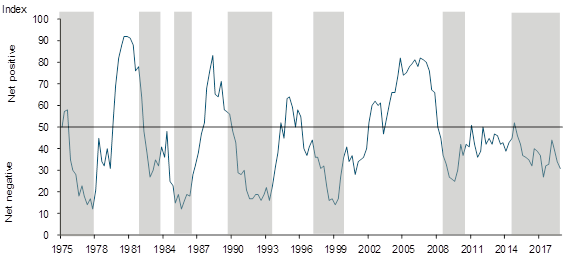
Figure 1: RMB/BER Business Confidence
Source: BER, SARB (Shaded areas represent economic downswings)
The fourth quarter survey was conducted between 31 October and 19 November. The fieldwork was therefore completed before the 25-basis point interest rate hike of last week, the cabinet reshuffle and “Black Friday” promotion sales. The survey covered 1 700 business people in the five cyclically-most-sensitive sectors of the economy i.e. building, manufacturing, retail, wholesale and new vehicle trade.
Even though improvements have been modest, it’s nonetheless encouraging to see confidence having risen in three out of the five sectors surveyed. In fact, if it wasn’t for the unusually large drop in new vehicle dealer confidence, the RMB/BER BCI would have risen for the first time in almost a year. Yet, concerns continue to linger; in aggregate, seven out of every 10 respondents remain unhappy with prevailing business conditions, while confidence continues to track below the neutral-50 mark in all the sectors.
“While President Ramaphosa’s refreshing new focus on public-private-sector partnerships is welcome, the reality is, a multitude of political and policy issues (chief amongst which is the uncertainty around the government’s land reform plans), continue to weigh down on confidence. Unless these are resolved in a more speedily and concrete fashion, private sector fixed investment, and by implication, economic growth will remain disappointingly low. Time is running out as global headwinds are mounting and domestically inflation as well as policy interest rates have bottomed” said Ettienne Le Roux, chief economist at RMB.
Usually, surveys make use of weights to provide for the fact that not all units of the population universe are quizzed. All the BER’s survey respondents are allocated sector and firm size weights to account for their main activity type and turnover respectively. Every few years, the BER updates the sector weights to provide for changes in the composition of activity. This time, the BER also reduced the number of firm size weight categories from nine to four to agree with the classification into micro, small, medium and large firms. The updated sector weights and the new four-category firm size weights were applied to the original individual responses (the so-called microdata) to recalculate all the historical time series going back to 1992. For more information, please see the note “Business confidence changes 18Q4” and download the revised historical BCI data at www.ber.ac.za
Our team of investment specialists is ready to discuss how we can help you achieve your financial objectives.



Our team of investment specialists is ready to discuss how we can help you achieve your financial objectives.