- Global Markets Overview | July 2026
Global Markets Overview | July 2026
07 August 2026
Share via:


Same trusted investment partner. Fresh new experience. Trust that you discover a faster, simpler and more intuitive online experience.
Beware of WhatsApp fraudsters using our name. We never offer investments or request personal info on WhatsApp.

Ashburton Fund Managers (Proprietary) Limited is a licensed Financial Services Provider ("FSP") in terms of the Financial Advisory and Intermediary Services Act, 37 of 2002, FSP number 40169, and Ashburton Management Company RF (Pty) Ltd is an approved manager of Collective Investment Schemes in terms of Collective Investments Scheme Control Act, 45 of 2002 by the Financial Sector Conduct Authority (FSCA) and is also a full member of the Association for Savings and Investment SA (ASISA).

2 Merchant Place, 1 Fredman Drive, Sandton, Johannesburg, 2196

+27(0) 860 000 339
Fully Invested
© 2026 Ashburton Investments. All rights reserved.

The brief “peace dividend” seen in June evaporated rapidly in July as the United States (US)-Iran ceasefire unravelled amid renewed military exchanges, driving oil prices sharply higher and reigniting geopolitical concerns. At the same time, the Federal Reserve's (Fed) hawkish interest rate stance unsettled bond markets, while a deepening artificial intelligence (AI)-driven valuation reset triggered significant losses across global semiconductor and technology stocks. Together, these developments weighed heavily on investor sentiment and erased much of the gains accumulated earlier in the year.
July delivered a second consecutive month of broad losses, with the MSCI World Index falling ~1.6% for the month, while the MSCI Emerging Markets Index experienced a far sharper drawdown of ~9.2% as a Korea-centred technology rout rippled across Asia and beyond. Three interlocking themes dominated the month: the complete collapse of the June memorandum of understanding (MOU) and resumption of active US-Iran hostilities; a deepening selloff in AI-linked semiconductor and mega-cap technology stocks driven by valuation concerns, circular financing fears, and China competitive risks; and a bond market revolt following the Fed's July “hawkish hold”, which was accompanied by three dissents in favour of a rate hike, sending the 30-year Treasury yield to its highest level since 2007.
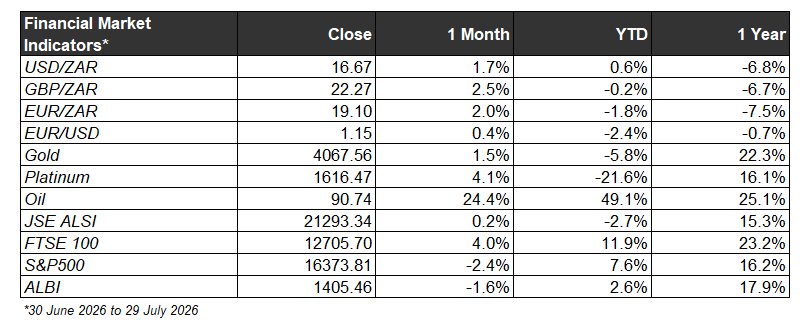
Global equities experienced a clear risk-off rotation with July being a pivotal month for the technology sector as investors increasingly differentiated between companies demonstrating tangible AI-driven revenue growth and those committing to ever-higher levels of capital expenditure. In the US, the S&P 500 fell ~2.4% amid sharp losses across most of the” Magnificent Seven” (-3%) as the Nasdaq 100 entered correction territory after falling more than 10%. Moving over to Europe, the Euro Stoxx 50 was slightly more resilient, declining by around 1.1% as the European Central Bank’s (ECB’s) “hold” and the region's domestic demand-driven recovery offered partial insulation from the AI trade unwind. Asian markets experienced a difficult month overall, with the MSCI Asia Pacific Index down ~6.7%, though with significant divergence across key markets. South Korea's KOSPI plunged 33%, making it the region's worst performer and reversing months of record highs, as investors questioned the sustainability of AI-related demand. Japan's Nikkei 225 fell 12.2%, with global risk-off sentiment outweighing support from a weaker yen. In contrast, Hong Kong's Hang Seng rose 13.1%, recovering much of the previous month's losses as Chinese technology and e-commerce stocks rebounded. Locally, the JSE All Share ended the month relatively flat in South African rand terms, though rand weakness translated this into a loss of ~2% in US dollar terms, with the South African Reserve Bank’s (SARB) surprise rate hold and accelerating consumer inflation (CPI) keeping sentiment cautious.
Monetary policy was a key theme this month, with central banks navigating a more uncertain inflation and growth backdrop. The ECB held its deposit rate steady at 2.25%, pausing after June's hike to assess the renewed impact of Middle East hostilities on inflation. The Fed kept rates unchanged at 3.5% to 3.75% for a fifth consecutive meeting, although the 9-3 vote sent a clear hawkish signal to markets. The Bank of England (BoE) left its bank rate unchanged at 3.75%, reflecting a balance between easing inflation and persistent risks from higher energy prices. The SARB also held rates steady at 7%, despite widespread expectations of a hike – the committee acknowledged that while inflation has been pushed higher by fuel costs and rising services inflation, policy is already somewhat restrictive following the previous rate increase. Looking ahead, the Bank of Japan (BoJ) is widely expected to hold its benchmark rate at 1.0% at its 31 July meeting, though officials are reportedly open to a faster pace of hikes given persistent yen weakness and underlying inflation running above the 2% target.
The defining commodity development of July was the swift reversal of June's oil price decline. Brent crude opened the month near ~$72/barrel and peaked at around ~$101/barrel, a gain of ~42%, as the ceasefire collapsed and Iran formally declared the Strait of Hormuz closed. A brief pause in US strikes in late July, accompanied by Oman-mediated talks, briefly pushed Brent back toward $80, before a resumption of hostilities and Iranian ballistic missile launches sent prices surging again. In terms of precious metals, gold ended the month at ~$4 067/ounce (oz.) (+1.4%), as the safe haven bid from the resumption of geopolitical risk was partly offset by a stronger US dollar and rising real yields following the Fed's hawkish tilt. Platinum rose 4.1% to ~$1 616/oz. as the metal attracted tactical flows on the back of strong fundamental support. The Bloomberg Agriculture Spot Index rose ~6.2%, reversing June's modest retreat, as renewed Hormuz disruptions reignited fertiliser and shipping cost concerns, with Chicago Mercantile Exchange (CME) reporting a sharp rise in demand for fertiliser futures.
Markets enter August with geopolitical risk firmly re-entrenched as the dominant macro variable. The prospect of a prolonged US-Iran conflict has increased, with officials from both sides describing a deadlock over the Strait of Hormuz. Looking ahead, the market performance in August is likely to hinge on three key factors: whether Oman-mediated talks can produce a durable framework for Hormuz shipping, with some tanker traffic reportedly resuming under US Navy escort, or if the conflict widens further toward critical energy infrastructure; whether the Fed's growing internal hawkish coalition translates into an actual September rate hike, now the base case for a growing number of market participants; and whether the AI investment theme can find a floor following the severe drawdowns in semiconductor names, or whether China's advancing chipmaking capabilities and circular financing concerns trigger a more sustained de-rating of the sector.

*Written by the FNB Wealth and Investments Research team
Our team of investment specialists is ready to discuss how we can help you achieve your financial objectives.



Our team of investment specialists is ready to discuss how we can help you achieve your financial objectives.