
Global Markets Overview | October 2026
06 November 2026

Ashburton Investments
Share via:


September's concentrated gains in technology and growth-oriented markets gave way to a sharply divergent October, as the artificial intelligence (AI) and semiconductor trade underwent an abrupt mid-month correction, Hormuz tensions deteriorated materially, and major central banks delivered a widely anticipated “pause”. Despite the reprieve from further tightening, markets found little comfort, with the global macro configuration remaining deeply challenging and dispersion across regions and sectors widening considerably
Global equity markets delivered a broadly mixed outcome in October (MSCI World: +0.74%; MSCI Emerging Markets: -6.52%), once again masking extreme dispersion beneath the surface. Three interlocking themes defined the month. First, major central banks held rates in line with consensus, providing a brief reprieve from the September tightening shock – though hawkish forward guidance kept the higher-for-longer narrative firmly intact. Second, the Strait of Hormuz situation deteriorated materially from September's already-elevated baseline amid escalating attacks with diplomatic efforts producing only tentative progress. Third, the AI and semiconductor trade that had powered September's technology rally underwent a painful mid-month correction (most acutely felt in chip-heavy Asian markets), as investors began questioning the pace and profitability of AI infrastructure spending across the ecosystem, before experiencing a partial recovery late in the month on the back of blockbuster earnings from South Korea's SK Hynix.
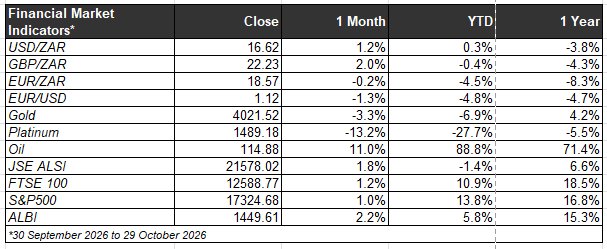
In the United States (US), the S&P 500 (+1%) delivered a solid gain, while the Nasdaq 100 (-3.29%) reversed course as AI enthusiasm gave way to profit-taking and concerns over the sustainability of hyperscaler capital expenditure. The US Federal Reserve (Fed) held rates steady at its October meeting in a 10-2 vote, maintaining the target range at 3.75% to 4%. Fed Chair Kevin Warsh emphasized the central bank’s "readiness to act as circumstances require" at the December meeting, noting that "the accumulation of more information will help the committee determine the policy stance appropriate to ensure a timely return of inflation to the committee's 2% goal". Against this backdrop, US Treasury yields moved lower, with both the 2-year and 10-year yields declining as the Fed's decision to remain on hold provided some relief to bond markets. Moving over to the eurozone, the Euro Stoxx 50 (-0.8%) was fairly volatile, weighed by global macro pressures as well as political instability in France. The European Central Bank (ECB) left its deposit rate on hold at 2.50%, in line with expectations, however, markets continue to price in a final 25-basis point (bp) hike in December. Asian markets delivered the month's starkest divergence. South Korea's KOSPI (-13.16%) was the worst-performing major index globally, as the AI and semiconductor trade unwound sharply. However, the KOSPI rallied ~6.63% on 28 October after SK Hynix reported a seven-fold surge in operating profit and announced a ~$45 billion shareholder return plan, reaffirming that memory chip shortages are expected to persist through at least 2030. Japan's Nikkei 225 (-3.14%) suffered materially, caught between the global AI selloff and a USD/JPY rate near 157.66 (~3.8% depreciation from the recent peak in July), though the weaker yen provided limited offset as export earnings faced headwinds from slowing global demand. The Bank of Japan (BoJ) held rates at 1.25%, in line with consensus, but remains committed to raising rates in response to any economic and price developments. Hong Kong's Hang Seng (-6.59%) continued to face pressure from US semiconductor restrictions on China and elevated energy costs. Locally, the JSE All Share gained 1.85%, supported by limited exposure to AI-driven market volatility and a “bond-friendly” medium-term budget that reinforced confidence in South Africa's fiscal trajectory through debt stabilisation and a proposed fiscal anchor. US dollar returns, however, were relatively flat as the rand weakened meaningfully towards month end.
Brent crude’s 11% surge to $114.88/barrel (bbl) was driven by a sharp increase in Iranian tanker attacks, a US advisory urging vessels that don’t need to transit the Hormuz area to avoid the region, and reports that Washington had warned several Gulf nations to prepare for a short, intense military campaign against Iran. While prices retreated from a monthly high of $117.38/bbl as physical market conditions showed tentative signs of easing, Brent remains near year-to-date highs, with pricing increasingly influenced by geopolitical risks rather than underlying supply fundamentals. Among precious metals, gold declined 3.2% to $4 021.52/ ounce (oz.), pressured by a firm US dollar and elevated bond yields that reduced the appeal of non-yielding assets. Platinum fell a steeper 13.2% to $1 489.18/oz., reflecting not only the same macroeconomic headwinds but also its greater exposure to industrial and automotive demand, which remains subdued. The Bloomberg Agriculture Spot Index fell ~5.1%, continuing its partial reversal of the supply-chain-driven gains seen in July and August.

Markets enter November navigating a macro environment that remains challenging but has evolved in important ways over the course of October. The coordinated central bank pause has provided a degree of breathing room, though forward guidance leaves little doubt that the tightening cycle is not yet complete. The Strait of Hormuz conflict has deteriorated further into active confrontation, though the late-October regional diplomatic push involving key regional powers represents the most substantive mediation effort to date. The risk of renewed military action against Iran nevertheless remains a significant tail wind. On the technology front, the late-month recovery was characterised as a fundamental re-anchoring, driven by hard earnings data, rather than a simple sentiment rebound. However, sustainability remains a key concern among investors. As a result, the key near-term catalysts to monitor include the trajectory of US-Iran negotiations and the risk of renewed military escalation, December central bank meetings (particularly the Fed and ECB, where further hikes remain the base case) and whether the broader technology earnings season validates SK Hynix's constructive read on AI infrastructure demand.

*Written by the FNB Wealth and Investments Research team

February delivered divergent returns across global equity markets (MSCI World Index: +1%) with emerging markets (MSCI Emerging Markets Index: +6%) once again significantly outperforming developed markets amid heightened volatility driven by AI disruption concerns, renewed tariff uncertainties, mixed interest rate expectations and ongoing geopolitical tensions, particularly between the United States (US) and Iran.

The Fund delivered +0.04% in December and -3.51% in the fourth quarter, versus +1.04% and +3.29%, respectively, for the MSCI World Index. At the start of the year, during the market drawdown between mid-February and early April, the Funds defensive characteristics contributed positively, delivering over 600 basis points of relative outperformance.

The first month of the new year was dominated by headlines surrounding geopolitical tension between the United States (US) and several nations as well as a fresh round of new tariff threats. This continued to fuel the sell America rhetoric, pushing the US dollar deeper into bearish territory towards levels last seen in 2022.

Global markets rose by 3.3% in the final quarter of the year. This was despite the longest US government shutdown in history and a softer US job market. The slowing labour market prompted the Federal Reserve to prioritise employment over inflation, cutting interest rates a further 25bps in December.

Global markets were mixed in November (MSCI World Index: +0.3%, MSCI Emerging Markets Index: -2.4%) as heightened volatility permeated through the equity and bond space. This was driven by uncertainty surrounding the United States (US) Federal Reserves path going forward as a delay in key economic releases due to the prolonged US government shutdown, left investors scrambling for clues on the Feds final move for the year.

We get it. "Financial planning" is a term that sounds like it belongs in a wood-panelled office, reserved for people who have already "made it." If you're in your twenties or thirties, you might think it's only for those nearing retirement, or that you simply don't have enough assets to justify it.
Global markets maintained positive momentum over the month of October (MSCI World Index: +2.0%) with emerging markets (MSCI Emerging Markets Index: +4.2%) outperforming once again as several regions, including Korea (MSCI Korea Index: +24.5%) and Taiwan (MSCI Taiwan Index: +10.8%), delivered robust performances amid ongoing optimism within the AI and semiconductor space.
The third quarter of 2025 ending 30th September was strong for global markets continuing the positive momentum which began in mid-April, boosted by tariff pull-backs, a de-escalation in trade tensions between the US and China and the passing of the One Big Beautiful Bill.
Financial markets performed well in August despite a cautious underlying tone across global markets. Investors continued to monitor ongoing tariff announcements, negotiations between the United States (US), Ukraine and Russia regarding a possible peace treaty, earnings from AI-related stocks, as well as key economic readings out of the US and how it may affect the US Federal Reserves interest rate path going forward.
News flow in July remained dominated by tariff negotiations, the health of the global economy and interest rate expectations. Investors kept a watchful eye on United States (US) President Donald Trump as several meetings with major trading partners took place ahead of the 1 August tariff deadline.
The second quarter of 2025 was strong for global markets. Starting off on a negative note with the announcement of President Trumps Liberation Day tariffs, global markets turned around strongly in mid-April boosted by tariff pull-backs, a de-escalation in trade tensions between the US and China and the passing of the One Big Beautiful Bill.

Despite ongoing waves on uncertainty, the recovery from the lows seen in April following President Donald Trumps Liberation Day continued into the month of May. This was a function of de-escalating trade tensions, possible ceasefires in ongoing conflicts and a reduction in the odds of a recession hitting the United States (US).

Despite ongoing waves on uncertainty, the recovery from the lows seen in April following President Donald Trumps Liberation Day continued into the month of May. This was a function of de-escalating trade tensions, possible ceasefires in ongoing conflicts and a reduction in the odds of a recession hitting the United States (US). Markets followed the whipsaw trend in reaction to President Trumps tariff announcements and delays, with key central bank meetings also dominating news flow.

Global markets experienced an extremely turbulent month, with volatility and uncertainty rising to unprecedented levels amid escalating trade tensions between the United States (US) and global trading partners, especially China, as well as a barrage of commentary from US President Trump regarding the efficiency and effectiveness of the US Federal Reserves (Fed) policy actions.

Global markets grappled with heightened uncertainty during March amid escalating tariff talks, United States (US) growth fears, and unprecedented policy uncertainty. Ongoing talks surrounding government spending cuts in the US also sparked some hesitation among market participants.

Weve made a small change to our logo. Well, a whole lot of small changes actually. And some to our corporate colours, typeface and layouts, too. In fact, when you put it all together, weve a made a big, bold and exciting change. Ashburton Investments. Fully invested.
The 2025 South African budget speech is set to be a defining moment for the country, outlining the governments fiscal strategy in a challenging economic landscape. While the State of the Nation Address (SONA) provides broad policy direction, the budget serves as a detailed plan for tackling issues such as state-owned enterprises, economic reform and fiscal sustainability.
Global markets delivered a sombre performance in July (MSCI World Index: -0.1%, MSCI Emerging Markets Index: -1%) as investors continued to assess key areas of interest including interest rate expectations, the political landscape in the United States (US), a selloff in China as well as ongoing geopolitical concerns in several regions
Our team of investment specialists is ready to discuss how we can help you achieve your financial objectives.
Our team of investment specialists is ready to discuss how we can help you achieve your financial objectives.