- Insights
- Articles
- Global Market Overview | July 2024
Global Market Overview | July 2024
05 August 2024

Ashburton Investments
Share via:


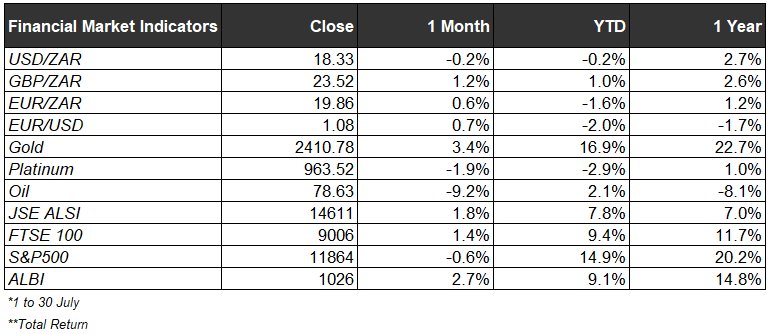
Global markets delivered a sombre performance in July (MSCI World Index: -0.1%, MSCI Emerging Markets Index: -1%) as investors continued to assess key areas of interest including interest rate expectations, the political landscape in the United States (US), a selloff in China as well as ongoing geopolitical concerns in several regions. Interestingly, we saw a pullback among the large tech companies, with the NYSE FANG+ Index falling approximately 6.7% as market participants herded capital towards the broader market as reflected by the strong performance in the Russell 2000 Index (10.5%).
At a headline level, US markets were relatively lacklustre, with the S&P 500 Index giving back 0.6% as investors continued to assess interest rate expectations while capturing recent profits and reallocating capital away from the tech mega caps. In terms of central bank activity, the Federal Reserve left rates unchanged for a seventh consecutive meeting in June, with policymakers noting that they do not expect it will be appropriate to reduce rates until they have gained greater confidence that inflation is moving sustainably toward the 2% target. The dot plot showed that policymakers see only one rate cut this year and four reductions in 2025. The interest rate futures market initially adjusted to the Fed’s forecasts but has once again become more enthusiastic about cuts with a cut fully priced in for September, and another two priced in before the end of the year (in November and December).
The Eurozone delivered a soft performance as well with the Euro Stoxx 600 Index increasing by a mere 0.3% amid heightened political uncertainty, while disappointing results out of several large cap counters contributed to the risk-off mood. The European Central Bank (ECB) also continued to garner attention following last month’s landmark cut. However, the central bank held rates constant at July’s meeting and reiterated that borrowing costs will remain “sufficiently restrictive for as long as necessary” to ensure inflation returns to 2%. Future decisions will depend on ongoing economic data, underlying inflation trends, and the effectiveness of monetary policy, with the Council not committing to a fixed path for rates.
China maintained its downward trend in July with the MSCI China Index giving back 3.7% as the highly anticipated Third Plenum meeting, in conjunction with a surprise rate cut, failed to restore investor sentiment. Based on the communique released, discussions at the plenum outlined broad goals such as boosting technology self-sufficiency, improving social welfare, and deepening reforms of the fiscal, taxation and financial systems. However, global investors were left disappointed by a lack of detail on how the region plans to address the most pressing issues plaguing its economy including sluggish consumer spending, a persistent property slump, and a mounting debt crisis facing municipalities around the country.
On the local front, the JSE All Share Index (+1.8%; USD: +1.7%) locked in another month of gains as upward momentum following the outcome of the recent election continued to support flows from local and offshore participants. The Monetary Policy Committee (MPC) decided to hold the repo rate unchanged at 8.25% at its July meeting. The decision was not unanimous, as two of the six members voted for a cut of 25bps. The South African Reserve Bank (SARB) noted that there are still upside risks to its inflation outlook but has revised its inflation forecast for 2024 to an average of 4.9%, down from 5.1% in May. While the SARB may only look to cut in November (trailing the Fed who is now expected to announce a cut in September), the cutting cycle is anticipated to be quite shallow – with one 25bps cut pencilled in for 2024 and two further cuts next year, after which rates are anticipated to remain steady for some time.
Economic Data Review
Expectations for the US Fed to begin rate cutting cycle in September
Flash estimates showed that the S&P Global Composite PMI for the US rose to 55 in July, its highest level since April 2022, and up from 54.8 in June. Manufacturing output saw its first decline since January, which resulted in the service sector outperforming manufacturing for the fourth consecutive month. Retail sales beat expectations and increased 2.3% y-o-y in June following an upwardly revised 2.6% increase in May. The trade deficit increased to approximately $75.1 billion in May, the largest since October 2022, moving from a downwardly revised $74.5 billion in April and below forecasts of a $76.2 billion gap. The unemployment rate increased to 4.1% in June, the highest since November 2021, up from 4% in May and exceeding market expectations for an unchanged reading. The annual inflation rate beat market expectations and fell to 3% in June, falling for the third consecutive month following a 3.3% rate in May. The Federal Reserve kept the Fed funds rate steady in June, as expected, for a seventh consecutive meeting. Policymakers do not expect it will be appropriate to reduce rates until they have gained greater confidence that inflation is moving sustainably toward the 2% target. Meanwhile, the dot plot showed that policymakers see only one rate cut this year and four reductions in 2025. In March, the Fed was seeing three cuts in 2024 and three in 2025. The Fed made no revisions to its GDP growth projections.
ECB held rates steady, maintaining their data-dependant approach
The HCOB Flash Eurozone Composite PMI retreated to 50.1 in July, the lowest in five months, from 50.9 in June – considerably below market expectations of 51.1. The reading highlighted a neat stagnation of the Eurozone private sector. Retail sales in May edged higher by 0.3%, beating a 0.4% forecasted decline following a 0.6% uptick in April. The Eurozone posted a trade surplus of about €13.9 billion in May, down from €15 billion in April, well below expectations of €18 billion. Annual inflation in the Euro area declined to 2.5% in June, in line with expectations, following May’s reading of 2.6%. The ECB decided to keep interest rates unchanged at 4.25% at the July meeting, in line with expectations. As some inflation indicators rose in May due to temporary factors, but most stabilised or fell in June. Despite high wage growth’s inflationary impact being mitigated by profits and monetary policy remaining restrictive, domestic price pressures and services inflation remain high, with overall inflation expected to stay above target into next year. The decision on rates will depend on ongoing economic data, underlying inflation trends, and the effectiveness of monetary policy as the Council has confirmed its flexibility and will adjust rates based on evolving data.
BoE to maintain restrictive monetary policy until inflation risks diminish
The S&P Global Composite PMI exceeded expectations of 52.6 and rose to 52.7 in July, signalling a strong upturn in private sector activity. This was the nineth consecutive expansion, with an average index level of 53 thus far in 2024. Retail sales declined 0.2% y-o-y in June below a forecasted 0.2% gain, following an upwardly revised 1.7% rise in May. The UK’s trade deficit regressed to £4.9 billion in May from a downwardly revised £6.4 billion in April. Imports slowed by 2.8% over the month to £74.7 billion, while exports declined by 0.9% to £69.8 billion. The unemployment rate in the UK was flat at 4.4%, in line with expectations. It remains the highest reading since September 2021. Annual inflation was steady at 2% in June, same as the previous month but above a forecasted 1.9%, with the largest upward contribution from costs of restaurants and hotels. The Bank of England (BoE) decided to maintain the repo rate at 5.25% during its June meeting, as expected. Some policymakers noted that the decision not to cut rates was “finely balanced”. The MPC acknowledged a looser labour market despite tight historical standards and is committed to maintaining a restrictive monetary policy until inflation risks diminish sustainably. They remain vigilant about persistent inflationary pressures and will adjust policy as necessary based on upcoming economic data and forecasts.
Sentiment surrounding China remains under pressure despite surprise rate cut
The Caixin China General Composite PMI softened to 52.8 in June from 54.1 in May. It was the eighth straight month of growth in private sector activity as output growth accelerated in the manufacturing sector but eased for services. Retail sales rose by 2% y-o-y in June, compared to a 3.7% gain in the previous month, falling short of market expectations of 3.3%. This was, however, the 17th consecutive month of growth in retail trade. China’s trade surplus beat expectations as it surged to approximately $99.1 billion in June from $69.8 billion in the same period last year. This was the largest trade surplus since July 2022, as exports increased while imports declined. China’s surveyed unemployment rate remained at 5% for the third consecutive month, in line with expectations. The annual inflation rate fell short of forecasts as it dipped to 0.2% in June from 0.3% in the prior two months. It was the fifth straight month of positive consumer inflation but the lowest since March amid a fragile economic recovery. The People’s Bank of China (PBoC) dropped key lending rates (below forecasts) to new record lows at the July fixing to assist a fragile economic recovery. The one-year Loan Prime Rate (LPR) was cut by 10bps to 3.35%. While the five-year rate, a reference to property mortgages, was trimmed by the same margin to 3.85%.
Bank of Japan (BoJ) implements surprise rate hike
The au Jibun Bank Flash Japan Composite PMI rose to 52.6 in July from 49.7 in June – the lowest reading in seven months – but signalled the sixth expansion in private sector activity year-to-date, predominantly supported by the strongest growth in three months for the service sector as manufacturing activity unexpectedly contracted. Retail sales edged higher by 3% y-o-y in May, accelerating from an upwardly revised 2.4% gain in April and exceeding market expectations for 2% growth. This was the 26th consecutive month of expansion in retail turnover as rising wages continued to boost consumption. Japan saw a trade surplus of ¥224.4 billion in June ahead of market forecasts of a deficit of ¥240 billion as exports grew higher than imports. It was the second surplus so far this year as shipments rose by 5.4% y-o-y, the seventh consecutive month of growth, supported by robust sales to main trading partners, notably China and the US. In June the unemployment rate stayed the same for the fourth consecutive month, at 2.6%, in line with expectations. The annual inflation rate remained at 2.8% in June, holding steady for the second straight month, in line with expectations. The BoJ raised its benchmark interest rate at the July meeting to “around” 0.25% from a range of 0% to 0.1%. This was against expectations of a steady outcome. The new overnight interest rate of 0.25% is the highest level since the global financial crisis. The last rate increase was in March – where the BoJ exited its years’ long negative interest rate regime. Policymakers also outlined plans to halve its monthly bond purchases.
Local sentiment continues to improve as recent cabinet announcement offers further stability
In May, the leading business cycle indicator contracted 1% m-o-m (well below forecasts of a 1.7% gain), and this pointed toward a sharp reversal from the previous month (an increase of 2.4%). The SACCI Business Confidence Index dropped to 107.8, marking a second consecutive monthly decline, with sentiment impacted by preceding fears over the local elections – as was the case for most of the surveyed data points released this month. Retail sales edged 0.8% higher y-o-y in May, from growth of 0.7% in April, and was well above expectations of a 1.2% decline. The trade balance amounted to a surplus of about R20 billion in June as exports surged by 5.7%, while imports declined 0.5%.
Local mining production was flat in May, following an increase of 1.4% in the prior month. This was below forecasts of 1.7% growth, with the index weighed by a decline in gold (-9.0%) and PGMs (-4.1%), offsetting good contributions from coal (+7%) and chromium ore (+17%). Manufacturing production retreated 0.6% y-o-y, significantly below forecasts (+3.2%), with basic iron and steel, non-ferrous metal products, metal products and machinery seeing a decline in output (-8.1% vs 3.6% growth in April). Composite PMI declined to 49.2 in June (from 50.4 in May and against expectations of 50.2), amid sluggish growth in the private sector. Manufacturing PMI rose to 45.7 but was below forecasts of 49.5 amid a further contraction in local factory activity.
Annual Consumer Price Inflation (CPI) dropped to 5.1% in June (in line with expectations), signalling further progress toward the SARB’s target of 4.5% amid softer price increases for food & non-alcoholic beverages, housing & utilities, health, and recreation & culture. Core inflation (which excludes the price of food, non-alcoholic beverages, fuel, and energy) edged lower to 4.5% near a five-month low. During its July meeting, the SARB kept its benchmark interest rate unchanged at 8.25% (as expected). The central bank believes that restrictive monetary policy is still “appropriate” in stabilising inflation. However, the consensus is shifting closer to a potential 25bps cut at the next meeting given an improving inflationary outlook.
Outlook
Local
Global
Our team of investment specialists is ready to discuss how we can help you achieve your financial objectives.
Our team of investment specialists is ready to discuss how we can help you achieve your financial objectives.