- Insights
- Articles
- Global Market Overview | July 2025
Global Market Overview | July 2025
13 August 2025

Ashburton Investments
Share via:


Written by the FNB Wealth and Investments Research team
News flow in July remained dominated by tariff negotiations, the health of the global economy and interest rate expectations. Investors kept a watchful eye on United States (US) President Donald Trump as several meetings with major trading partners took place ahead of the 1 August tariff deadline. However, trade deal optimism waned as tariff discussions progressed. Thus far, only a handful of regions including the European Union (EU), Japan, Philippines, Indonesia, and the United Kingdom (UK) have struck “best-possible” framework deals with the US. However, Chinese officials and the US remain in intense discussions to try and reach a broader conclusive trade agreement. Despite these uncertainties, global markets remained resilient with emerging markets outperforming developed peers (MSCI World Index: +1.3%, MSCI Emerging Market Index: +2.0%) amid another stellar performance out of China.
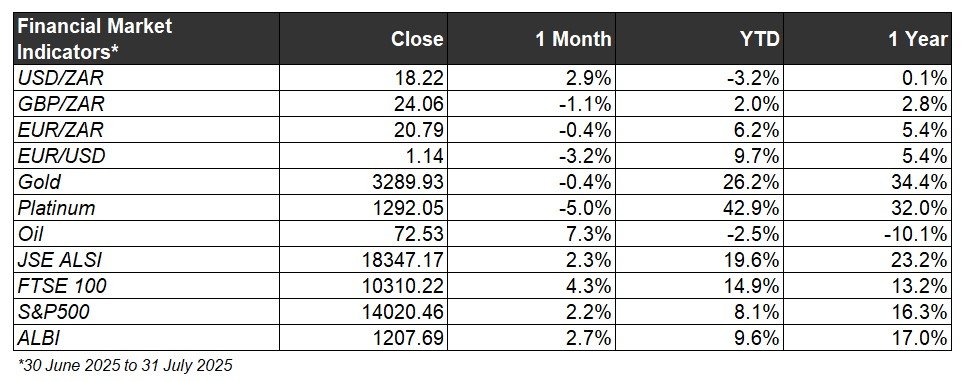
Looking more closely at the US, the S&P 500 Index added 2.2% with recent dollar strength, continued strength in tech stocks, and robust economic readings providing some support despite investors expressing caution over ongoing trade talks and central bank independence. In terms of the Federal Reserves’ policy announcement, the committee held rates steady at 4.25% to 4.50% for a fifth straight meeting, as expected, but two governors dissented in favour of a cut – this was the first double dissent since 1993. Fed Chair Jerome Powell said interest rates are in the right place to manage continued uncertainty around tariffs and inflation, also tempering expectations for a rate cut in September. Officials downgraded their view of the US economy, saying that growth had “moderated” in the first half of the year, having previously characterised growth as expanding “at a solid pace”. The committee remained of the view that the labour market is “solid” and inflation “remains somewhat elevated”, also repeating that uncertainty “remains elevated”.
Moving over to the Asia-pacific region, the MSCI China Index rallied 4.8% as markets participants continued to cheer ongoing stimulus measures and a handful of positive economic readings. On the flipside, US and Chinese negotiators have not settled on a trade deal yet but have agreed, in principle, to push back the deadline for escalating tariffs. Another 90-day delay is a possibility, according to US Treasury Secretary Scott Bessent, however, any extension would need President Trump’s approval. Chinese trade negotiator, Li Chenggang, also confirmed that both sides agreed on maintaining the truce, without elaborating on how long it will last.
European markets logged marginal gains with the Euro Stoxx 600 Index trading 1.0% higher by month end. Ongoing concerns about the health of the European economy persisted amid a mixed bag of economic data. European Commission President Ursula von der Leyen and President Trump announced that the US and EU had agreed on a major trade deal, establishing a new baseline for transatlantic commerce and setting a 15% tariff ceiling (half the 30% rate previously indicated by President Trump) on most EU exports to the US. In terms of monetary policy movements, the European Central Bank (ECB) kept interest rates unchanged in July, effectively marking the end of its current easing cycle after eight cuts over the past year which brought borrowing costs to their lowest levels since November 2022. ECB President, Christine Lagarde, noted that the central bank is “in a good place” but will maintain a “wait-and-see” approach due to the difficulty in assessing how tariffs will affect price outlooks, given a mix of both inflationary and disinflationary pressures.
The local bourse locked in decent gains over the month in rand terms (All Share Index: +2.3%, USD terms: -0.4%), with resource counters being among the top performers. The South African Reserve Bank (SARB) was also in the spotlight, unanimously reducing interest rates by 25bps to 7%, the lowest level since November 2022. The cut was widely anticipated amid concerns over a new US tariff regime threatening the already fragile economy. Policymakers emphasised ongoing global uncertainty, noting that many countries have yet to finalise trade agreements before the US tariff deadline. Local investors now look ahead to the tariffs that are planned to be imposed on South Africa, with some speculating that local exports will face similar tariff levels to other non-major US trade partners (perhaps around the 15% to 20% level), while others expect a higher percentage to be imposed initially which will then be reduced later once the US and SA reach a conclusive deal. Department of Trade, Industry and Competition (DTIC) Minister, Parks Tau, recently reiterated that a "reset is unavoidable" in the trade relationship between the two nations and that government officials have no intention of decoupling from the US.
Outlook
Local
Global
Our team of investment specialists is ready to discuss how we can help you achieve your financial objectives.
Our team of investment specialists is ready to discuss how we can help you achieve your financial objectives.