- Insights
- Articles
- 2025 Market Overview-the year that was
2025 Market Overview-the year that was
09 January 2026

Ashburton Investments
Share via:


written by the FNB Wealth and Investments Research team
“Uncertainty” was among the top contenders for the word of the year in financial market circles in 2025, reflecting just how often the term was used in reference to the global economic environment and financial markets.
Indeed – it was a year marked by the start of a second Trump presidency that has, among others, included sweeping tariffs by the United States (US) on friend and foe alike, a gutting of federal departments, threats to the independence of the Federal Reserve, the BIG BEAUTIFUL BILL, wavering commitment to support NATO allies in their defence efforts, and the longest federal government shutdown on record. All the while, the AI thematic continued to gain traction and likely protected US growth and equity market returns. Elsewhere there were major leadership shakeups in large economies including Japan and Germany and continued political chaos in France and the United Kingdom (UK).
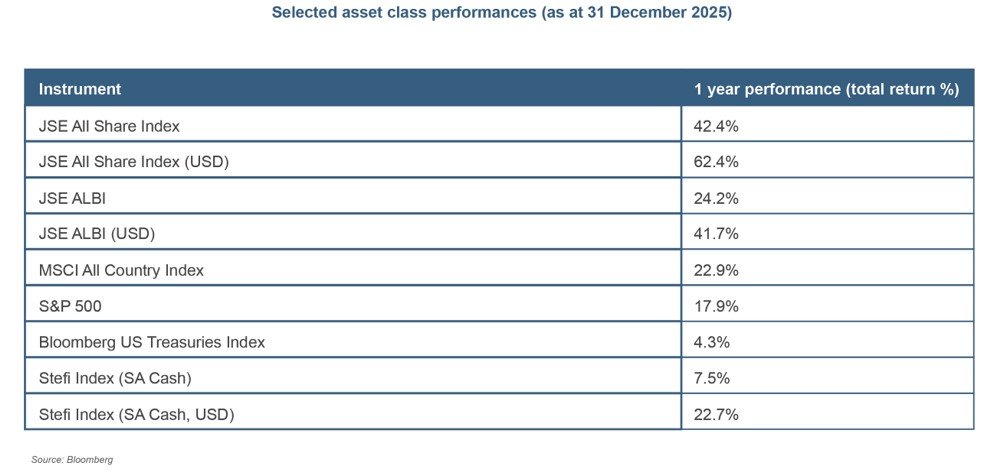
Pretoria was drawn into a bizarre diplomatic tiff with the White House that started with attempts to reach a trade deal but ended in a PowerPoint of false accusations and the US boycotting the Johannesburg G20 meetings. Still, local risk assets performed exceptionally well, and the rand strengthened as key local factors supported the country’s investment case.
At the start of 2025, we were nervous around the prospects for the US under another Trump presidency as well as persistent political and geopolitical risk. We had a notable bias towards South African risk assets given an anticipated improvement in growth.
We anticipated higher volatility under a Trump presidency. Additionally, we were concerned over the inflationary impact of tariffs and tax cuts already proposed by Trump on his campaign trail. We were also not overly positive on US equities considering high valuations at the end of last year.
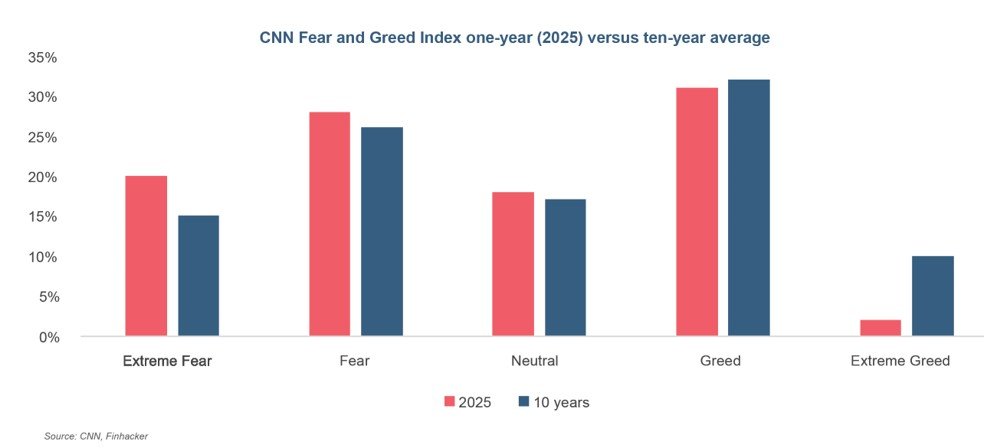
An announcement on tariffs was therefore expected, but the spectacle of the “Liberation Day” announcement and the quantum of the tariffs announced took the market by surprise. What followed was a deep sell-off across risk assets and continued strength in safe-haven assets like gold. Volatility spiked and sentiment became more fearful. Equity markets recovered, but uncertainty remained elevated, with large swings more common place and investors clearly remaining nervy.
We saw a notable shift in global investment flows out of the US and into other developed markets like Europe and major emerging markets including China. The US dollar weakened.
Global geopolitics and ongoing global fracturing were top of mind. With two ongoing wars and the prospect of tariff disputes, we were concerned.
For much of the year, geopolitics played a major role in shaping investor sentiment. On the trade front, major and smaller economies scrambled to negotiate trade deals with the White House, with Europe, China and Japan receiving most of the attention. Agreements or in-principle arrangements were negotiated – most at much higher tariff levels than before Liberation Day and much higher than what most economists and investors expected prior to that.
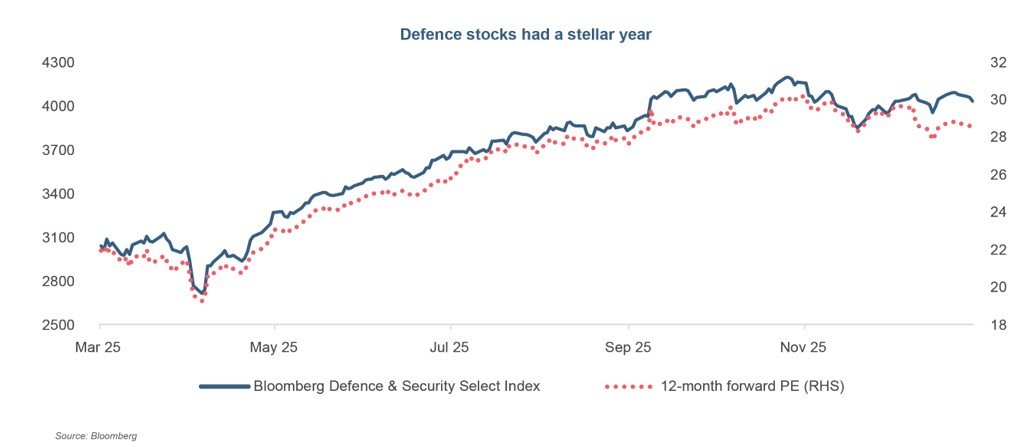
President Trump’s America First doctrine extended to NATO. Pressure mounted on America’s NATO partners to increase their defence spending – resulting in stocks in this sector soaring.
While we were positive on the prospects for AI, we underestimated the quantum of investment and thrust of the trade. We were concerned over starting valuations but recognised that earnings momentum was strong.
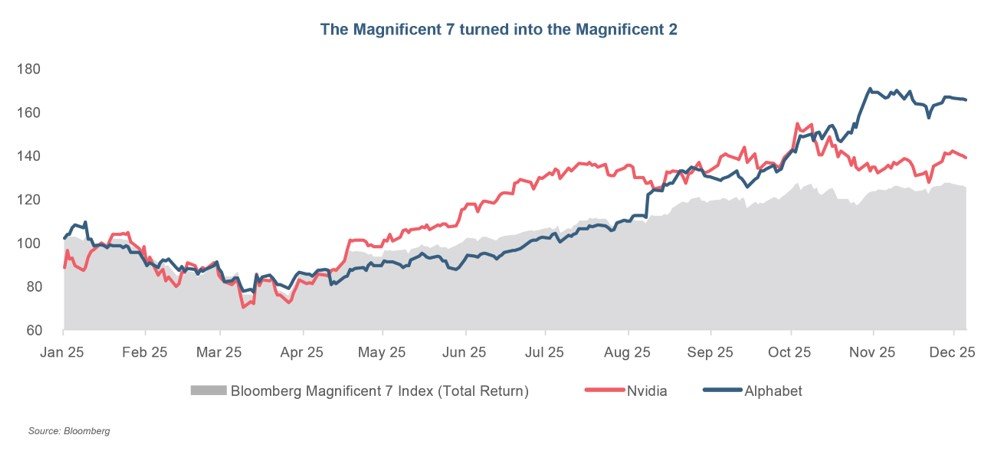
AI-focused stocks had a slow start to the year and were also sold off post-Liberation Day. The recovery began in late April and most of the larger stocks exposed to the thematic posted solid gains throughout the year. The rally lost some momentum in October as valuation fears surfaced once again. Several prominent financial market figures questioned the ultimate efficacy of large-scale investment taking place and the “bubble” question re-emerged, with several circular investments and accusations of imprudent accounting stoking negative sentiment.
Nvidia and Alphabet were the clear winners from a return perspective, with Nvidia supporting the rally for most of the year, while Alphabet drove aggregate Magnificent 7 returns later in the year. Notably, Alphabet started the year with the lowest relative valuation in the basket and showed arguably the most progress made in its AI offering – helping the share price along.
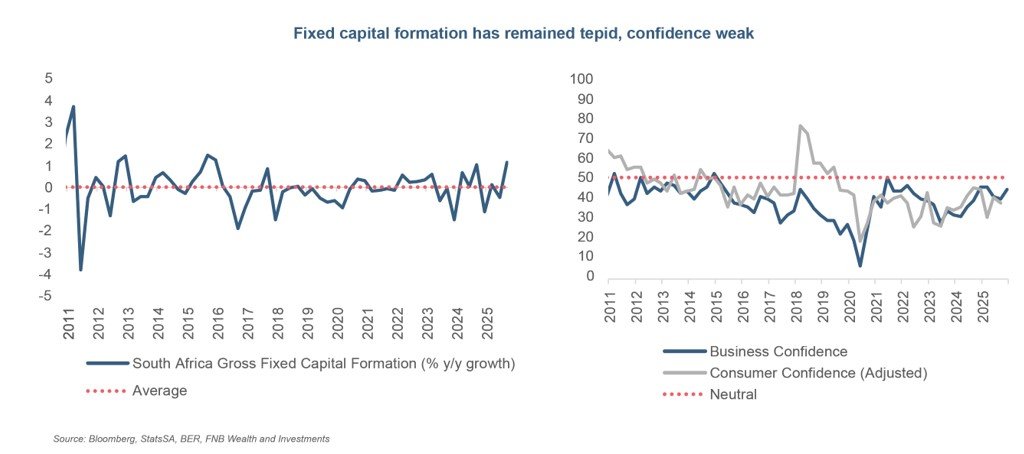
In SA, we saw growth lifting to just below 2.0%. This was anticipated to be a function of an improvement in confidence, steady energy supply, lower inflation, interest rate relief, and a continued increase in fixed investment (off a low base).
The Liberation Day tariff announcement caught investors off guard, but economists also had to quickly adjust their assumptions in the face of what was expected to be a major disruptor to trade and, by extension, global economic growth. While global growth held up reasonably well overall, in South Africa, the tumultuous external environment (and indeed our increasingly “awkward” relationship with the US) notably dragged on confidence and kept private sector investment in check.
Growth expectations were pulled back through the middle of the year and currently we expect 2025 real GDP growth to come in at just 1.3%.
We were positive on local risk assets – notably equities and bonds. We anticipated that the election outcome, coupled with incremental delivery on Operation Vulindlela, and a possible upgrading of South Africa’s sovereign credit rating in the second half of 2025, would be potential catalysts.
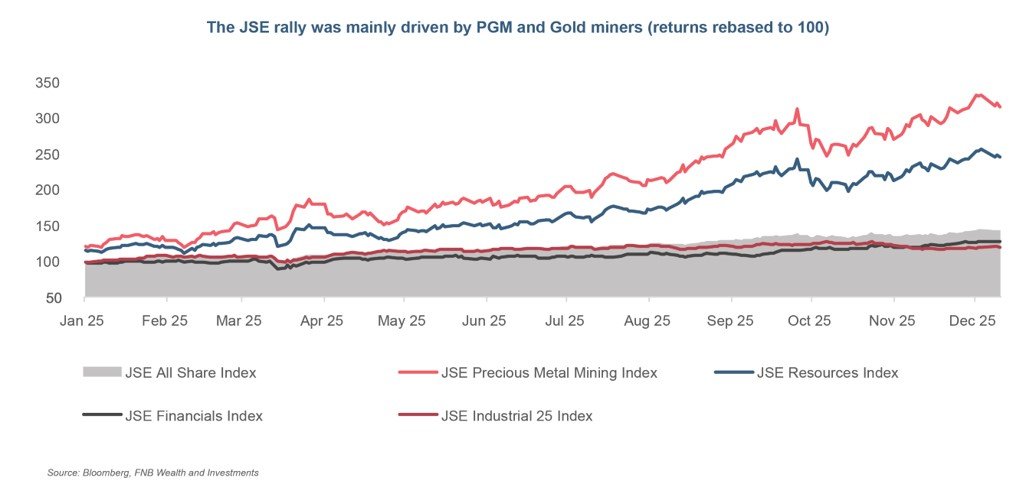
It was indeed a very good year for South African equities and bonds. The bond outperformance was a function of several notable developments in the year – strong interest in emerging market fixed-income instruments, a lower inflation target by the South African Reserve Bank (SARB) (later endorsed by National Treasury), an improved fiscal position (helped by high commodity prices, buoyant tax receipts and conservative spending), South Africa’s removal from the Financial Action Task Force (FATF) grey list, and a ratings upgrade by S&P Global. Equities were supported by a strong run in precious metal prices that resulted in very strong returns from the gold and PGM miners (making up 25% of the index as at 30 November). Up until mid-November, tech heavyweights, Naspers and Prosus (14% of the index), were also strong performers but softness into December limited the overall contribution to index outperformance.
In equities, SA Inc underperformed and notably foreign flows remained very soft outside of the resources space. Foreign flows were also much more buoyant in South African bonds and will have also supported the ongoing strong performance for the asset class.
2026 – The year ahead
When considering our expectations and positioning for 2026, it is interesting that while a lot has happened in 2025, our investment outlook is not much changed relative to the start of the year.
Despite a challenging global backdrop, South Africa’s economy has demonstrated resilience. Structural reforms and continued fiscal improvement signal an emerging growth recovery path. We expect real GDP growth to rise to 1.4% in 2026.