- Insights
- Articles
- Global Markets Overview | September 2026
Global Markets Overview | September 2026
08 October 2026

Ashburton Investments
Share via:


August's broad-based recovery gave way to a more uneven market environment in September as the United States (US) Federal Reserve's (Fed) first interest rate hike in more than three years, a renewed breakdown in Strait of Hormuz diplomacy, and the breakout launch of Meta's Muse personal artificial intelligence (AI) agent pulled markets in competing directions. As a result, September's gains were concentrated in technology and growth-oriented markets, while rate-sensitive and commodity-importing regions came under pressure. The month concluded with geopolitical risk intensifying, bond markets flashing recession warnings, and monetary policy tightening on multiple fronts simultaneously.
Global equity markets delivered a relatively neutral outcome in September (MSCI World Index: -0.8%; MSCI Emerging Markets Index: -0.4%), masking sharp dispersion beneath the surface as the month was impacted by three interlocking themes. First, the Fed delivered a widely anticipated yet symbolically significant 25-basis point (bp) rate hike, with the hawkish chorus among committee members cementing expectations for higher rates going forward. Second, the fragile Iran-Oman shipping framework that had capped oil prices in August collapsed, reigniting the acute supply disruption premium and pushing Brent crude well above the $100/barrel mark once again. Finally, Meta’s launch of its Muse personal AI agent was met with an exceptionally strong response, rapidly becoming the top-ranked application on the Apple App Store and Google Play within days, and sparking a broad-based rally across semiconductor stocks.
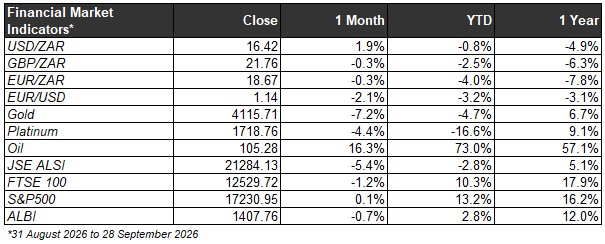
In the United States (US), the Nasdaq 100 (+2.8%) was the standout performer globally, fuelled by AI enthusiasm, while the S&P 500 (+0.1%) delivered a more muted return as the Fed’s rate hike weighed on equity valuations. Meta shares surged ~25% for the month, pushing its market capitalisation to the cusp of $2 trillion, with optimism quickly spreading across the broader AI ecosystem. Moving over to the Eurozone, the European Central Bank (ECB) lifted its deposit rate by 25bps to 2.50%, its second hike since the Iran war broke out, citing a renewed surge in energy-related inflation. As a result, the Euro Stoxx 50 fell 1.8%. Asian markets delivered mixed performances over the period, with South Korea's KOSPI (+1%) ranking among the strongest-performing major global equity indices. However, momentum eroded after the Bank of Korea warned of heightened global financial market uncertainty following a sharp rise in international bond yields. Japan's Nikkei 225 dipped marginally by 0.7% as the Bank of Japan’s (BoJ) 25bp rate hike and a widening US-Japan rate differential (driven by the Fed's simultaneous hawkish hike) kept the yen near 157/$, weighing on export earnings and dampening the index's traditional currency tailwind. In contrast, Hong Kong's Hang Seng Index fell 3.2%, pressured by ongoing US restrictions on Chinese access to advanced semiconductor technology and higher energy costs as China competed aggressively for alternative crude oil supplies. Locally, the JSE All Share fell ~5.4%, and was down ~7.1% in US dollar terms, as the South African Reserve Bank’s (SARB) unanimous 25bp rate hike in conjunction with lower domestic growth forecasts compounded the effects stemming from global pressures. Collectively, the hawkish rhetoric across major central banks reinforces expectations for a higher-for-longer global interest rate environment, with markets continuing to price further tightening across several major economies into 2027.
The fragile Iran-Oman equilibrium of August broke down in September as two supertankers were struck near the Strait of Hormuz, pushing Brent to a monthly high of just over ~$109/barrel. Diplomatic activity at the United Nations General Assembly (UNGA) briefly offered relief, but President Trump's rejection of Iran's ceasefire proposal towards month-end left Brent hovering around $105/barrel – a monthly gain of ~17.3%. In terms of precious metals, gold fell ~7.2% to $4 115.71/ounce (oz.) as the dollar strengthened on the Fed's hawkish pivot. Platinum similarly lost traction, declining ~4.4% to $1 718.76/oz. The Bloomberg Agriculture Spot Index fell 4.3%, partially reversing July and August's supply-chain-driven gains as some alternative shipping routes normalised.

Markets enter October navigating a more challenging macro configuration than a month ago. The simultaneous tightening by major central banks, against a backdrop of a near-inverted US yield curve and Brent near $105/barrel, raises concerns about a broader global growth slowdown. The Strait of Hormuz situation has deteriorated from August's fragile equilibrium back toward active confrontation, leaving the diplomatic path unclear. On the technology front, Muse has set a new benchmark for consumer AI adoption, although emerging privacy concerns have introduced a degree of uncertainty around the sustainability of that momentum. As a result, the key near-term catalysts to monitor include the trajectory of US-Iran negotiations, the next round of central bank meetings in October (particularly the Fed, ECB and BoJ), and whether Muse's privacy controversy materially dents the consumer AI adoption curve that has underpinned September's technology outperformance.

*Written by the FNB Wealth and Investments Research team
Our team of investment specialists is ready to discuss how we can help you achieve your financial objectives.
Our team of investment specialists is ready to discuss how we can help you achieve your financial objectives.