- Insights
- Articles
- Global Markets Overview | August 2026
Global Markets Overview | August 2026
04 September 2026

Ashburton Investments
Share via:


July’s sharp losses gave way to a broad-based recovery in August, as a pivotal earnings report from Nvidia restored confidence in the artificial intelligence (AI) investment theme, diplomatic progress on the Strait of Hormuz kept oil prices range-bound, and resilient risk appetite drove gains across most major equity markets. While the geopolitical backdrop remained fragile and the United States (US) Federal Reserve’s (Fed) hawkish posture intensified heading into September, the month ultimately delivered meaningful positive returns across global equities.
Global equity markets locked in robust gains over the month of August (MSCI World Index: +2.9%; MSCI Emerging Markets Index: +3.6%) as three interlocking themes drove a partial reversal of July's losses. The US-Iran conflict entered a more managed phase as the Strait of Hormuz saw limited shipping resume under a nascent Iran-Oman framework, easing the acute supply disruption premium that had dominated July. Simultaneously, Nvidia's blowout second-quarter earnings and an exceptionally strong projection forecasting 70% revenue growth for the next fiscal year shattered Wall Street estimates and reignited faith in the AI boom. Against this, the Fed’s annual Jackson Hole symposium delivered a fresh hawkish jolt, with Chairman Kevin Warsh warning that inflation has not meaningfully slowed and that the central bank retains the readiness to act, sending September rate hike odds sharply higher into month end.
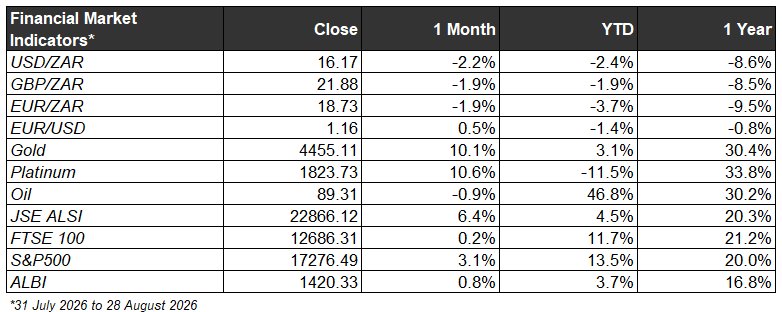
While global equities staged a recovery, August was defined by sharp intra-month volatility and significant divergence across sectors and geographies. In the US, the S&P 500 rose 3.1% and the Nasdaq 100 gained 4.2%, with AI trade finding renewed conviction following Nvidia's earnings announcement – the share surged ~9% on the day, adding roughly $442 billion in market value and triggering a broad rally across AI-adjacent names. The results served as a critical barometer for the health of hyperscaler AI capital expenditure, easing fears that the investment cycle was losing momentum. In Europe, the Euro Stoxx 50 gained 2.1%, the most modest gain among major developed-market indices as the region’s relative underexposure to AI-linked names meant it captured less of the Nvidia-driven tech rally that propelled US and Asian markets higher. In Asia, the MSCI Asia Pacific Index added ~3.2%, though with significant divergence. South Korea's KOSPI rebounded 3% from July's severe drawdown and Japan's Nikkei 225 rose 3.2%, supported by a weaker yen and improving global risk appetite. In contrast, Hong Kong's Hang Seng fell 1%, reversing a portion of July's strong gains as Chinese technology stocks gave back some of their recent advance amid renewed US scrutiny of Chinese firms' access to Nvidia chips. Locally, the JSE All Share was a standout performer among emerging markets, rising 6.4% amid a double-digit rally in the Resource sector (+31%). The rand strengthened ~2% against the US dollar over the month, hitting a monthly low of R15.93/USD on 25 August, amplifying the Johannesburg Stock Exchange’s gains to ~8.8% in US dollar terms.
Monetary policy remained on hold across all major central banks in August, but the tone shifted decisively more hawkish as the month progressed. The pivotal moment arose at the Jackson Hole Economic Policy Symposium where Fed Chairman Kevin Warsh, in his first major keynote address since taking the helm, sent an unambiguously hawkish signal to markets. Warsh warned that the central bank still has "work to do" on inflation, signalling that further interest rate hikes remain on the table and cementing a September rate hike as the base case for a growing number of market participants. Two additional Fed officials, including Kansas City Fed President Jeff Schmid, separately argued that current policy may in fact be accommodative rather than restrictive, adding further weight to the hawkish coalition.

The defining commodity development of August was the partial normalisation of Strait of Hormuz shipping, which capped, but did not reverse, July's oil price surge. Brent crude opened the month near ~$82.80/barrel, reflecting some carry-over from July's geopolitical premium, and peaked at ~$94.83/barrel on 21 August as Iran launched ballistic missiles toward the Strait. A subsequent Iran-Oman revenue-sharing agreement, combined with the US Navy establishing operational dominance over more than 80% of liquid transits via the Omani route, pushed Brent back to close the month at ~$89.31/barrel, a gain of ~7.9% for August. Precious metals were the standout performers during the month. Gold rose 10.1% to ~$4 455/ounce (oz.), primarily driven by a surprise US Treasury announcement to significantly increase purchases of long-dated government bonds which pressured the dollar and reignited fiscal debasement concerns, pushing investors toward hard assets including gold and Bitcoin (+23% to ~$77 405). Combined with ongoing safe-haven demand amid geopolitical uncertainty and continued buying by the People's Bank of China (PBoC), gold reached a three-month high of just over $4 657/oz. by 25 August. Platinum rose ~10.6% to ~$1 824/oz., supported by the gold momentum “spillover” as well as strong fundamental demand and tactical inflows. The Bloomberg Agriculture Spot Index rose ~13.4%, extending July's gains as ongoing Hormuz disruptions continued to inflate fertiliser and shipping costs, with supply-chain uncertainty compounding the pressure on agricultural commodity prices.

Markets enter September with a more constructive tone than a month ago, although several key risks remain unresolved. The Strait of Hormuz situation has moved from an acute crisis toward a fragile, transactional equilibrium with limited shipping traffic reportedly resuming through an Iran-approved corridor and Tehran signalling that renewed diplomatic engagement with the US is "not impossible". Attention is now turning to monetary policy, with the 16 September Federal Open Market Committee meeting representing the most important near-term macro catalyst as markets price in a roughly 59% probability of a 25-basis point (bp) rate hike. The Bank of Japan’s (BoJ) September meeting carries similar weight for Asian markets, with a hike now being the base case for several major forecasters. Finally, the AI investment theme has found a near-term floor courtesy of Nvidia, but the broader question of whether hyperscaler capital expenditure can sustain the sector's elevated valuations remains open.

*Written by the FNB Wealth and Investments Research team
Our team of investment specialists is ready to discuss how we can help you achieve your financial objectives.
Our team of investment specialists is ready to discuss how we can help you achieve your financial objectives.